
|Halea Life Editorial Staff
healthy Living · Stress & Mood Support
The Top 3 Supplements for Supporting a Healthy Stress Response — What the Research Actually Shows
Ashwagandha, Magnesium, and 5-HTP are three of the most evidence-backed supplements for supporting the body's natural response to everyday stress. Here's the science, the mechanisms, and the Halea Life formulas built around them.
Feeling stressed, overwhelmed, or on edge is among the most common daily health concerns reported by adults — and it's one of the areas where nutritional science has made the most meaningful progress in identifying specific, well-researched interventions. Not every supplement in this space has strong evidence. But several do — and their mechanisms are increasingly well-understood at the level of neurotransmitters, hormones, and the body's physiological stress regulation systems.
This post covers the three supplements with the strongest combined evidence for supporting a healthy response to everyday stress: Ashwagandha, Magnesium, and 5-HTP. Each works through a distinct mechanism — the HPA axis, GABA neurotransmitter function, and serotonin precursor availability respectively. Understanding what each one actually does makes it easier to identify which one, or which combination, fits your specific situation.*
All health claims in this post reflect structure/function language appropriate for dietary supplements. These supplements support normal physiological stress response function — they are not treatments for diagnosed anxiety disorders, which require clinical evaluation and care.
01
Adaptogen · HPA Axis · Cortisol Regulation
Ashwagandha — The Most Clinically Studied Adaptogen for Stress Resilience
Evidence snapshot: Multiple randomized, double-blind, placebo-controlled trials. The largest, a 2019 study in Medicine, found that 240mg KSM-66 daily for 60 days produced significant improvements in stress and anxiety scores and measurably reduced morning cortisol in healthy adults under chronic stress.1
Ashwagandha (Withania somnifera) is classified as an adaptogen — a compound that helps the body maintain a more balanced physiological response to stress rather than forcing a specific outcome. Its primary mechanism is modulation of the HPA axis: the hypothalamic-pituitary-adrenal system that governs cortisol release. By influencing the feedback loops that regulate cortisol production, ashwagandha helps support the body's ability to respond to stressors without maintaining a chronically elevated stress state.*
The active compounds are withanolides — a class of steroidal lactones unique to ashwagandha that have been studied for their interactions with cortisol receptors, GABA receptors, and inflammatory signaling pathways. KSM-66 is the most clinically studied root-only extract form, with the most robust body of peer-reviewed evidence across stress, sleep, and cognitive outcomes.*
A 2012 randomized controlled trial in the Indian Journal of Psychological Medicine found that 300mg KSM-66 twice daily for 60 days significantly reduced scores on standardized stress assessment scales and reduced serum cortisol by 27.9% compared to placebo.2 A separate 2021 study in Medicine confirmed these findings at a single daily 240mg dose.1 The evidence across multiple trials is unusually consistent for an herbal supplement — particularly in the area of cortisol modulation.*
HPA Axis Modulation
Supports the feedback loops that regulate cortisol production, helping maintain a more balanced physiological stress response with consistent daily use.*
GABA Receptor Activity
Withanolides have demonstrated affinity for GABA-A receptors — the primary inhibitory neurotransmitter system that counteracts neurological over-excitation.*
Sleep Quality Support
Reduced cortisol and GABA receptor activity both contribute to improved sleep onset and quality — one of the most consistent secondary findings across ashwagandha trials.*
Cognitive Performance
Multiple trials have documented improvements in memory, reaction time, and cognitive task performance alongside stress reduction — reflecting the cognitive cost of chronic stress.*
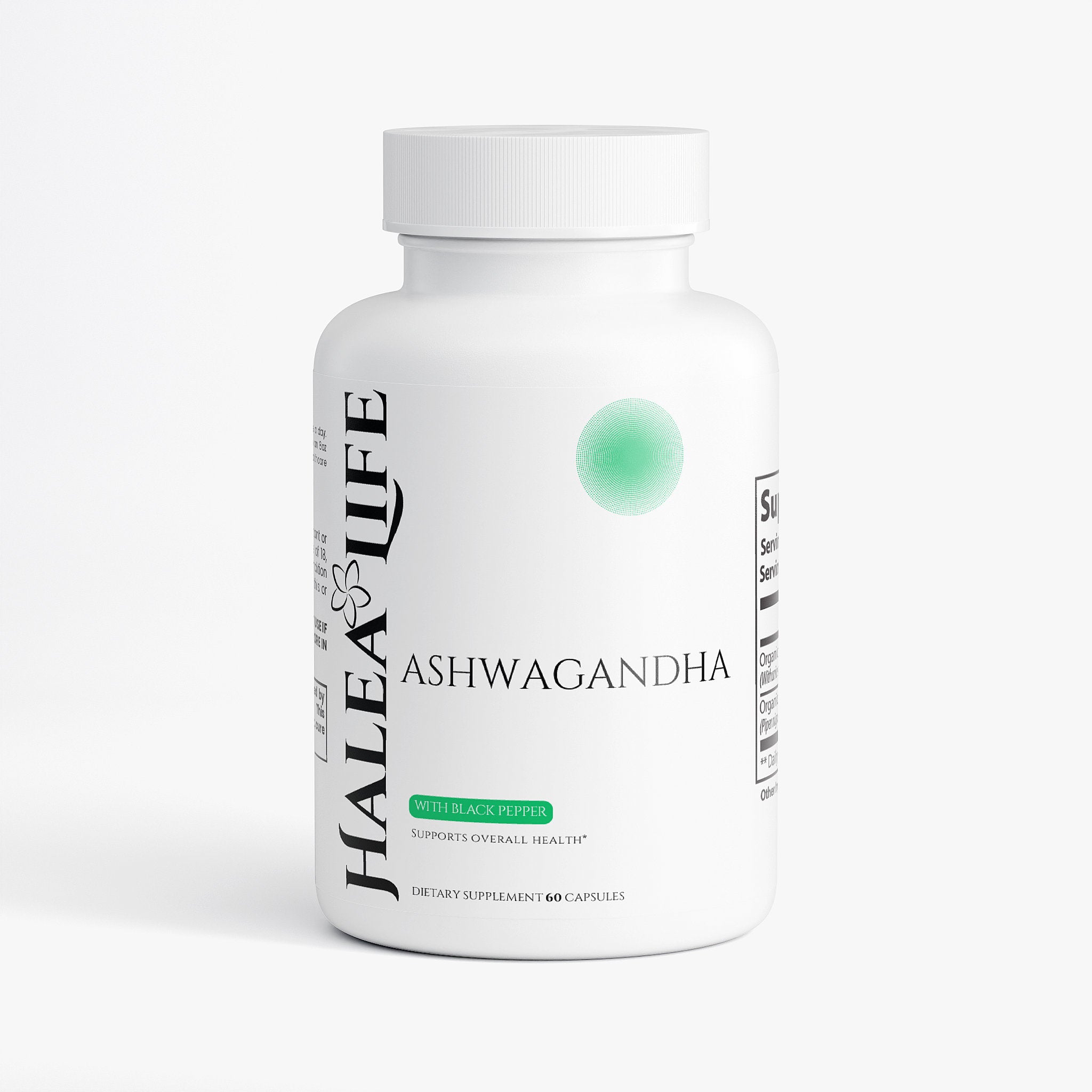
650 mg · Organic · Daily
Organic Ashwagandha
KSM-66 root extract with black pepper (piperine) for enhanced bioavailability. The foundational daily adaptogen for consistent stress support.*

600mg KSM-66 · Sleep + Energy
KSM-66 Ashwagandha Plus
Higher-potency formula at the clinical dose with additional support for sleep quality and daytime energy — for those whose stress is significantly disrupting both.*
"A 2012 RCT found that KSM-66 ashwagandha at 300mg twice daily reduced serum cortisol by 27.9% and significantly improved standardized stress assessment scores compared to placebo over 60 days."2
02
GABA Co-factor · NMDA Antagonist · HPA Modulation
Magnesium — The Most Overlooked Deficiency in Stress Management
Evidence snapshot: A 2017 systematic review in Nutrients examining 18 studies concluded there is consistent evidence for magnesium's role in supporting a healthy subjective stress and anxiety response, with the strongest evidence in populations with suboptimal magnesium status — which affects up to 50% of adults in developed countries.3
Magnesium is not an adaptogen — it's an essential mineral that the body requires for over 300 enzymatic reactions, including those that directly regulate the neurological systems involved in the stress response. When magnesium levels are suboptimal, the physiological stress response becomes harder to regulate: GABA receptor function is impaired, the HPA axis becomes more reactive, and NMDA receptor activity — the excitatory counterpart to GABA — increases, contributing to the feeling of being wired, on edge, or unable to wind down.*
The mechanism is straightforward: magnesium acts as a natural NMDA receptor antagonist, blocking the calcium channel that NMDA receptors use to trigger neuronal excitation. It also supports GABA receptor binding — the brain's primary braking system — making the nervous system more capable of returning to a regulated baseline after stress exposure. These aren't subtle effects in deficient individuals; they're foundational to how the brain manages excitatory tone.*
The challenge is that standard blood serum tests frequently miss intracellular magnesium deficiency — most of the body's magnesium is inside cells, not circulating in blood. A person can have normal serum magnesium while being functionally deficient at the cellular level. Dietary intake has also declined significantly over the past 50 years due to soil mineral depletion, making dietary sources increasingly insufficient for many adults.*
GABA Receptor Support
Magnesium supports GABA-A receptor function — the primary inhibitory neurotransmitter system. Deficiency directly reduces the brain's capacity to counteract excitatory stress signals.*
NMDA Receptor Antagonism
Blocks the excitatory NMDA receptor calcium channel, reducing neurological over-excitation associated with the heightened stress reactivity of magnesium deficiency.*
Sleep Quality
A 2012 RCT found magnesium supplementation significantly improved sleep quality, sleep time, and morning cortisol in older adults — effects that are directly linked to HPA modulation.*4
Glycine Co-benefit (Glycinate Form)
Magnesium glycinate binds magnesium to glycine — an inhibitory neurotransmitter that acts on glycine receptors in the CNS, adding independent calming activity to the magnesium effect.*

275mg · Chelated · Highest Bioavailability
Highly Bioavailable Magnesium Glycinate
Magnesium glycinate — chelated to glycine for superior absorption and zero laxative effect. Best taken in the evening. The form that actually raises intracellular magnesium levels.*
03
Serotonin Precursor · Mood Regulation · Sleep Onset
5-HTP — The Direct Serotonin Precursor for Mood Stability and Emotional Balance
Evidence snapshot: A 2012 review in CNS Neuroscience & Therapeutics examining multiple randomized trials concluded that 5-HTP supplementation produces reliable increases in central serotonin levels and supports improvements in mood and stress-related emotional regulation across multiple study designs.5
5-Hydroxytryptophan (5-HTP) is the direct metabolic precursor to serotonin — the neurotransmitter most closely associated with mood stability, emotional regulation, and the subjective sense of wellbeing. Unlike tryptophan (the amino acid further upstream in this pathway), 5-HTP crosses the blood-brain barrier directly and is converted to serotonin without requiring the rate-limiting enzymatic steps that make tryptophan supplementation less reliable for raising brain serotonin levels.*
The relationship between serotonin and the stress response is bidirectional: chronic stress depletes serotonin through a combination of increased consumption and reduced synthesis, while low serotonin makes the stress response more intense and harder to regulate. 5-HTP supports serotonin replenishment through the most direct dietary pathway available — providing the precursor molecule the brain uses to synthesize serotonin without requiring additional cofactors beyond vitamin B6, which is typically present in adequate amounts.*
5-HTP also serves as a precursor to melatonin via a secondary enzymatic step — which gives it a secondary benefit for sleep initiation alongside its primary mood-support role. Several clinical trials have found that 5-HTP supplementation at doses of 100–300mg daily supports improvements in mood, emotional balance, and sleep quality in non-clinical populations.*5,6
Serotonin Synthesis Support
Directly provides the precursor molecule the brain uses to produce serotonin — bypassing the rate-limiting upstream steps that limit tryptophan's effectiveness.*
Mood Stability
Serotonin is the neurotransmitter most directly associated with emotional regulation and subjective mood. Supporting serotonin availability supports the neurochemical foundation of mood stability.*
Sleep Onset
5-HTP converts to melatonin via a secondary enzymatic step, providing sleep initiation support alongside its serotonin-mediated mood benefits — particularly relevant when stress disrupts sleep.*
Stress-Serotonin Depletion
Chronic stress accelerates serotonin consumption. 5-HTP directly addresses the depletion pathway — making it particularly relevant for people whose stress is persistent rather than episodic.*

Serotonin Precursor · Mood · Sleep
5-HTP
Direct serotonin precursor that crosses the blood-brain barrier. Best taken in the evening. Do not combine with SSRIs, SNRIs, or other serotonergic medications without medical supervision.*
Getting the Most From These Supplements
Five Practical Notes Before You Start
01
Consistency Over Weeks
Ashwagandha and magnesium work through accumulation — their most meaningful effects develop after 4–8 weeks of daily consistent use. Taking them only on stressful days misses how they work.*
02
Time Them Deliberately
Ashwagandha: morning or evening. Magnesium glycinate: evening — supports sleep and overnight nervous system regulation. 5-HTP: evening — supports serotonin → melatonin conversion for sleep.
03
5-HTP Drug Interaction
5-HTP must not be combined with SSRIs, SNRIs, MAOIs, or other serotonergic medications — this combination can cause serotonin syndrome, a serious medical condition. Review with a healthcare provider before starting.
04
Stack All Three if Appropriate
Ashwagandha (HPA axis), Magnesium (GABA/NMDA), and 5-HTP (serotonin) work through entirely different mechanisms and can be taken together safely for people not on serotonergic medications.*
05
These Are Not Treatments
These supplements support normal physiological stress response function. They are not substitutes for clinical evaluation and treatment of diagnosed anxiety disorders. If you are experiencing significant distress, please consult a healthcare provider.
The Bottom Line
Three Distinct Mechanisms. Each Addressing a Different Part of the Picture.
Ashwagandha modulates the HPA axis and cortisol regulation — the hormonal layer of the stress response. Magnesium supports GABA and NMDA receptor function — the neurological layer. 5-HTP addresses serotonin availability — the neurochemical mood regulation layer. They are complementary rather than redundant, and together they cover the three most evidence-supported nutritional mechanisms for supporting a healthy daily stress response.*
Start with the one that maps most directly to your current primary concern — persistent cortisol-driven stress and low resilience (Ashwagandha), neurological over-excitation and poor sleep (Magnesium), or mood variability and emotional balance (5-HTP) — and build from there.
No subscriptions. No promo codes. The price you see is the price, year-round.
Scientific References
Sources Cited in This Article
1. Pratte MA, et al. An alternative treatment for anxiety: a systematic review of human trial results reported for the Ayurvedic herb ashwagandha (Withania somnifera). Journal of Alternative and Complementary Medicine. 2014;20(12):901–908.
2. Chandrasekhar K, Kapoor J, Anishetty S. A prospective, randomized double-blind, placebo-controlled study of safety and efficacy of a high-concentration full-spectrum extract of ashwagandha root. Indian Journal of Psychological Medicine. 2012;34(3):255–262.
3. Boyle NB, Lawton C, Dye L. The effects of magnesium supplementation on subjective anxiety and stress — a systematic review. Nutrients. 2017;9(5):429.
4. Abbasi B, et al. The effect of magnesium supplementation on primary insomnia in elderly: a double-blind placebo-controlled clinical trial. Journal of Research in Medical Sciences. 2012;17(12):1161–1169.
5. Birdsall TC. 5-Hydroxytryptophan: a clinically-effective serotonin precursor. Alternative Medicine Review. 1998;3(4):271–280.
6. Shaw K, Turner J, Del Mar C. Tryptophan and 5-hydroxytryptophan for depression. Cochrane Database of Systematic Reviews. 2002;(1):CD003198.
7. de Baaij JH, Hoenderop JG, Bindels RJ. Magnesium in man: implications for health and disease. Physiological Reviews. 2015;95(1):1–46.
8. Panossian A, Wikman G. Effects of adaptogens on the central nervous system and the molecular mechanisms associated with their stress — protective activity. Pharmaceuticals. 2010;3(1):188–224.
Shop Stress & Mood Support
Ashwagandha, Magnesium Glycinate, and 5-HTP — three complementary mechanisms for daily stress resilience and emotional balance.
Shop Stress & Mood →* These statements have not been evaluated by the Food and Drug Administration. These products are not intended to diagnose, treat, cure, or prevent any disease. This article is for educational and informational purposes only and does not constitute medical advice. 5-HTP should not be combined with SSRIs, SNRIs, MAOIs, or other serotonergic medications. If you are experiencing significant anxiety or stress, please consult a qualified healthcare provider. If you are in crisis, contact the 988 Suicide and Crisis Lifeline by calling or texting 988.