
|Halea Life Editorial Staff
Skincare Science · Niacinamide
Does Niacinamide Actually Fade Dark Spots? What the Research Says
Niacinamide gradually fades many types of dark spots by blocking the transfer of pigment inside your skin, not by bleaching it. Clinical trials back topical formulas in the 2% to 5% range, usually paired with a second brightening ingredient and always with daily sunscreen.
It works best on surface-level discoloration like post-inflammatory marks and sun spots, more slowly on melasma, and it will not touch pigment sitting deep in the dermis. For that, you need a dermatologist.
TL;DR
- Niacinamide effectively fades surface-level hyperpigmentation such as post-inflammatory marks and sun spots but is less capable of targeting deep dermal pigment like severe melasma.
- The best results occur with 2% to 5% formulations applied twice daily, paired with consistent sunscreen use and gradual introduction of other actives like retinoids or acids.
- Clinical evidence shows visible improvement typically begins after 4 to 8 weeks, with more noticeable changes around the 12-week mark, especially for epidermal dark spots.
- Higher concentrations above 10% can cause irritation in sensitive skin, potentially worsening pigmentation, so moderate doses backed by research are the safest starting point.
- Severe or persistent pigmentation should prompt consultation with a dermatologist, particularly for cases with a dermal component or no improvement after three months of consistent use.
Halea Life
halealife.com
Support Your Beauty Routine
Halea Life offers three serums targeting dark spots and uneven tone: the Dark Spot Serum for Normal Skin (four brightening actives), the Dark Spot Serum for Sensitive Skin (botanical mushroom-based brightening), and the Vitamin Glow Serum with Niacinamide, stable Vitamin C and Vitamin E.
Shop Brightening Serums →Table of Contents
- What Is Niacinamide for Hyperpigmentation and When Does It Work?
- How Does Niacinamide Treat Dark Spots at the Cellular Level?
- How to Use Niacinamide for Dark Spots
- Who Should Be Careful With Niacinamide?
- How Long Does It Take to See Results?
- Halea Life's Approach to Niacinamide and Dark Spot Care
- A Closing Take on Realistic Expectations
- Sources
- FAQ
Understanding Hyperpigmentation
What Is Niacinamide for Hyperpigmentation and When Does It Work?
Not all dark spots are the same, and that distinction decides whether niacinamide will actually do anything for you. Dermatologists split hyperpigmentation into two broad categories: epidermal and dermal. Epidermal pigment sits in the top layer of skin, close enough to the surface that topical ingredients can reach the melanocytes producing it. Dermal pigment sits deeper, often trapped in immune cells called melanophages, and creams generally cannot reach it no matter how well formulated they are.
Post-inflammatory hyperpigmentation (PIH) is the classic epidermal case. It shows up after acne, a cut, a bug bite, or an aggressive facial. Sunspots (solar lentigines) from years of UV exposure also live mostly in the epidermis. Melasma is trickier. It often has both epidermal and dermal components, which is why it responds inconsistently to the same treatments that clear up a pimple mark in weeks.
Knowing which category you are dealing with changes the entire plan:
- PIH from acne or minor trauma tends to respond well to niacinamide because the pigment is superficial and often already fading on its own.
- Sunspots respond more slowly since they have usually been building for years or decades.
- Melasma frequently needs a combination approach. Severe or long-standing cases may require prescription treatment or in-office procedures.
- Dermal pigmentation (post-inflammatory marks present for years, some melasma) may not visibly improve with topicals alone.
UV exposure is the biggest trigger by far, which is why dermatology guidance returns to sun protection as the foundation of any pigmentation treatment. Inflammation from acne, eczema flares, or physical irritation triggers melanocytes to overproduce pigment as a defensive response. Hormonal shifts from pregnancy, birth control, or hormone therapy drive melasma specifically.
If you do not know which type of pigmentation you are treating, you are guessing at a solution. A dermatologist using a Wood's lamp can often tell in minutes whether your discoloration is primarily epidermal or has a significant dermal component. Worth knowing before you invest months into a serum that was never going to reach the pigment causing the problem.
The Mechanism
How Does Niacinamide Treat Dark Spots at the Cellular Level?
Niacinamide does not stop your skin from making pigment. It stops that pigment from reaching the surface. This is the detail most product descriptions skip, and it is the one that actually explains how the ingredient behaves in practice.
Hydroquinone and vitamin C work mainly by inhibiting tyrosinase, the enzyme that converts tyrosine into melanin. Niacinamide takes a different route: it interferes with the transfer of melanosomes (the pigment packets) from melanocytes into the surrounding keratinocytes. Less pigment gets handed off, less shows up in the visible layers of skin. That is a meaningfully different mechanism, and part of why niacinamide tends to be gentler than tyrosinase inhibitors while working more gradually.
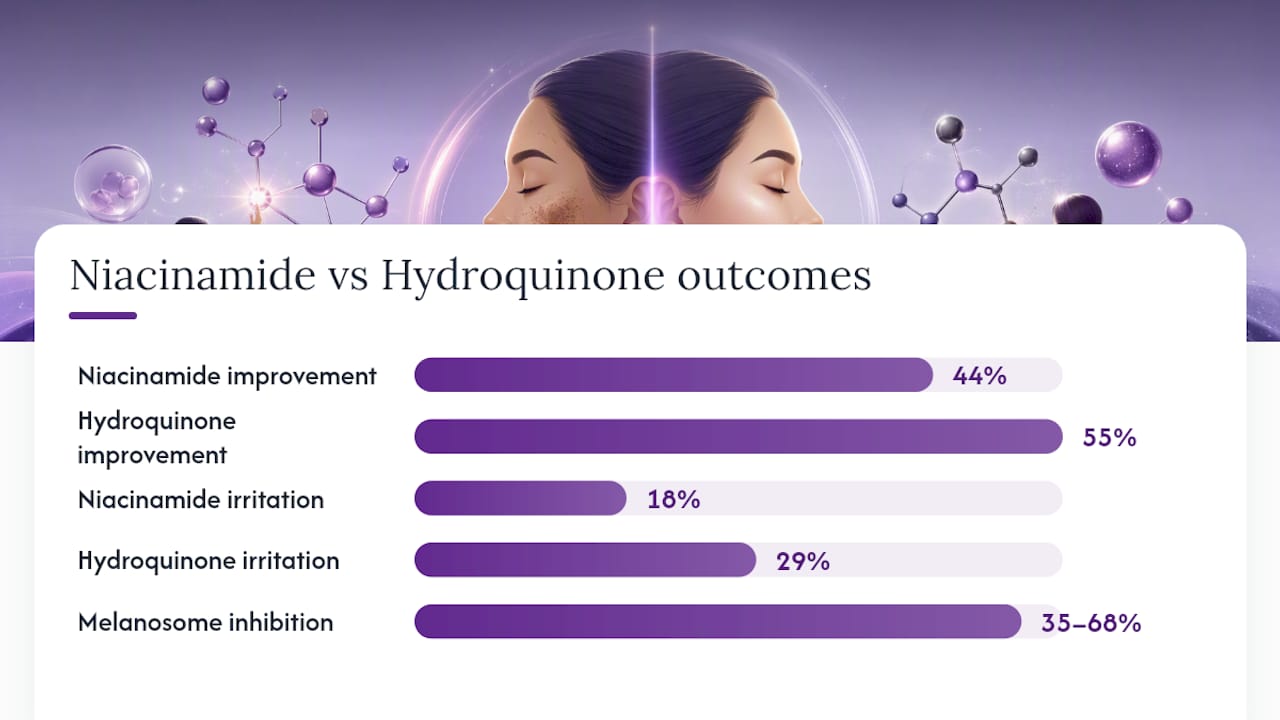
The foundational data comes from 2002 laboratory and clinical work, which found that niacinamide produced 35% to 68% inhibition of melanosome transfer in a coculture model, alongside measurable decreases in facial hyperpigmentation after just 4 weeks of using a 5% formula.
The Numbers That Matter
In a 2011 randomized, double-blind, split-face trial comparing 4% niacinamide to 4% hydroquinone over 8 weeks in melasma patients, niacinamide produced good-to-excellent improvement in 44% of treated sides versus 55% for hydroquinone, a real but not dramatic gap. Side effects told a different story: only 18% of niacinamide-treated sides reported irritation, compared to 29% on the hydroquinone side. That trade-off is the whole story in one data point. See the full trial: PMC3142702.
Hydroquinone edges out niacinamide on raw effectiveness, but at a meaningfully higher irritation cost, and irritation itself can worsen pigmentation in some skin types. Niacinamide gives up a bit of speed for a much gentler ride.
A 2009 combination trial reinforces a point worth taking seriously: the niacinamide plus N-acetyl glucosamine formula significantly outperformed vehicle with SPF 15 alone after 10 weeks in women aged 40 to 60. Notice that even the control group wore sunscreen. Sun protection was the baseline, not the variable being tested. Most of the strongest niacinamide data comes from combination formulations rather than the ingredient used entirely alone, so treat "niacinamide clears dark spots" as a helpful simplification of a more layered reality, not a literal guarantee for a single-ingredient product.
How niacinamide blocks melanosome transfer from melanocytes to keratinocytes, reducing visible pigmentation in the skin's surface layers.
Practical Guidance
How to Use Niacinamide for Dark Spots
Getting the concentration and routine right matters more than which brand you pick. Here is a practical sequence.
1
Pick a concentration in the 2% to 5% range. This is the band with actual clinical support. Going higher than 5% does not appear to improve results and raises your irritation risk for no real benefit. If you have sensitive or reactive skin, start at the lower end.
2
Patch-test for 3 to 5 days on your inner forearm or behind your ear before applying near your face. Niacinamide is well tolerated by most people, but "most" is not "all."
3
Choose your formulation type. Serums deliver a more concentrated, faster-absorbing dose and layer easily. Moisturizers with niacinamide are lower maintenance but usually at lower potency. Combination formulas pairing niacinamide with N-acetyl glucosamine have direct clinical backing behind that specific pairing.
4
Apply in the morning after cleansing, before sunscreen. Niacinamide is stable in daylight and works well as a base layer under SPF.
5
Use it again at night if your skin tolerates twice-daily use, ideally after cleansing and before a heavier moisturizer.
6
Never skip sunscreen. This is not optional. Every clinical trial showing niacinamide's benefit either paired it with sunscreen or measured it against a sunscreen-only baseline. UV exposure actively drives new pigment production, undoing whatever progress your serum is making.
7
Introduce retinoids and acids gradually, on a separate schedule. A common approach: niacinamide in the morning, retinoid at night, with AHAs or BHAs used on alternate evenings rather than stacked with the retinoid.
Pro Tip: If you are using a vitamin C serum and a niacinamide serum in the same routine, apply the more acidic, lower-pH product first and let it absorb for a few minutes before layering niacinamide on top. This is not about them "canceling out," despite what older internet folklore claims. It is about giving each product room to do its job at the pH it needs, which minimises pilling and irritation.
Shopping for a niacinamide product gets easier once you know what to check. Look at the ingredient list position: if niacinamide sits near the top, it is likely formulated at a meaningful concentration. Buried near the bottom, it is probably a token amount. Fragrance-free formulas cut down on one of the most common causes of unnecessary irritation. If you have reactive or eczema-prone skin, a lower-concentration, minimal-ingredient formula will usually serve you better than a serum stacking six actives at once.
Who Needs to Be Careful
Who Should Be Careful With Niacinamide?
Niacinamide has one of the better safety profiles among brightening ingredients, but "well tolerated" does not mean "risk-free for everyone." The irritation problem is the one that catches people off guard. Higher concentrations, especially above 10% in some formulas, can cause redness, stinging, or a mild rash in sensitive skin types. And irritation itself can trigger new post-inflammatory hyperpigmentation, a brightening treatment that causes the exact problem it was supposed to fix. This is precisely why the clinical trials that showed real results used moderate 4% concentrations rather than maximum-strength formulas.
A few situations call for a dermatologist conversation before you start:
Pregnancy-related melasma
Hormonal melasma often needs a broader treatment plan, and some ingredients used alongside niacinamide are not pregnancy-safe. Get guidance before starting.
Active acne lesions or open skin
Introduce niacinamide once inflammation calms down, not on top of active breakouts where the barrier is compromised.
Recent chemical peels or laser treatments
Give your skin barrier time to recover before adding new actives. Typically a week or more depending on the procedure depth.
No change after 12 weeks of consistent use
That is a signal to see a dermatologist rather than switching products indefinitely. The pigmentation may have a dermal component that topicals cannot reach.
Layering rules matter here too. Niacinamide generally pairs safely with retinoids and with AHAs or BHAs, but stacking all three in the same routine on the same night raises your irritation odds substantially. Space them out. For melasma that has not responded after a few months of a solid topical routine, or for pigmentation confirmed as dermal, prescription options and procedures move from something to consider to genuinely necessary.
Setting Realistic Expectations
How Long Does It Take to See Results With Niacinamide?
Patience is the unglamorous part of this whole approach, and it is exactly where most people quit too early. The clinical trials behind niacinamide's reputation did not show dramatic overnight change. They showed measurable improvement building over 4 to 8 weeks, with more complete results typically visible around the 12-week mark.
Tracking progress accurately requires more discipline than most people expect. Bathroom mirror lighting changes daily. Your mood changes how critically you look at your reflection. Here is the photo protocol the same clinical trials used to measure real change:
Photo Protocol
Track Progress the Way Clinical Trials Do
Wk 0
Baseline Photo
Same room, same light source (daylight near a window), no makeup, neutral expression. This is your reference point before anything changes.
Wk 4
First Checkpoint
Repeat the exact same setup. For many people this is still too early to see dramatic change. That is normal, not a sign of failure.
Wk 8
Clinical Window Opens
This is where most clinical improvement starts becoming visible in trial data. Most people will see something meaningful here if it is going to work.
Wk 12
Full Assessment
Line all four images side by side rather than comparing week 12 to your memory of week 1. No improvement by now is a real signal to see a dermatologist.
Halea Life Skincare
Halea Life's Approach to Niacinamide and Dark Spot Care
Halea Life offers three serums that address the dark spot mechanisms discussed throughout this post. Each is formulated for a different skin type and tolerance level, reflecting the core research point: niacinamide works best when matched to how sensitive your skin actually is, and the multi-pathway approach consistently outperforms any single-ingredient formula.

Normal Skin · Four Brightening Actives
Dark Spot Serum for Normal Skin
Kojic Acid and Hexylresorcinol (two tyrosinase inhibitors working through different structural mechanisms), Niacinamide (melanin transfer blocker), and Azelaic Acid (additional tyrosinase inhibition with clinical evidence). Four actives, four mechanisms, for skin that can tolerate a comprehensive active approach.
Kojic Acid
Hexylresorcinol
Niacinamide
Azelaic Acid
Normal Skin

Sensitive Skin · Botanical Brightening
Dark Spot Serum for Sensitive Skin
Shiitake Mushroom Extract (contains kojic acid precursors and natural tyrosinase inhibitors with significantly less irritation than isolated kojic acid), Turkey Tail Mushroom Extract (polysaccharide antioxidant activity), Chamomile and Calendula for soothing support. The formula for skin that has found conventional brightening actives too irritating.
Shiitake Mushroom Extract
Turkey Tail Mushroom
Chamomile
Calendula
Sensitive Skin

All Skin Types · Niacinamide + Stable Vitamin C
Vitamin Glow Serum: Niacinamide, Vitamin C & E
Niacinamide (B3) for tone and pore support, 3-O-Ethyl Ascorbic Acid (a stable vitamin C derivative that converts to active ascorbic acid in the skin without the oxidation instability of L-ascorbic acid), and Vitamin E and Panthenol for antioxidant protection and conditioning. All three brightening and protection mechanisms in one fragrance-free daily serum.
Niacinamide
3-O-Ethyl Ascorbic Acid
Vitamin E
Panthenol
Fragrance-Free
All Skin Types
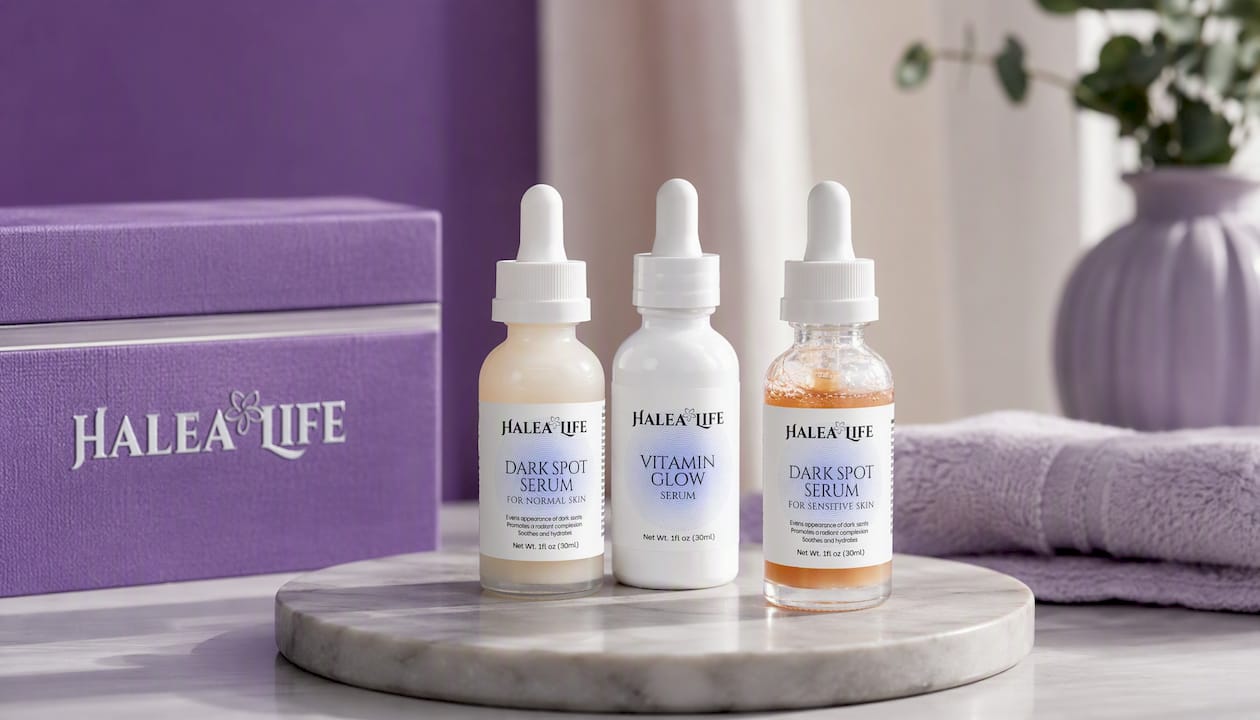
Halea Life skincare serums formulated around clinical evidence, not marketing trends.
Realistic Expectations
A Closing Take
Niacinamide is not a fast fix, and it is better to say that plainly than to let a serum label do the overselling. The path that actually works looks unglamorous: sunscreen every single morning, a niacinamide formula matched to how sensitive your skin actually is, and 8 to 12 weeks before you judge whether it is working. Pick your formula honestly, based on how your skin has reacted to actives before, not on how stubborn your spots are. If nothing has shifted after three months of consistent use, that is not failure. That is data telling you it is time to see a dermatologist.
Niacinamide isn't a fast fix, and I'd rather tell you that plainly than let a serum label do the overselling for me. The path that actually works looks unglamorous: sunscreen every single morning, a niacinamide formula matched to how sensitive your skin actually is, and 8 to 12 weeks before you judge whether it's working.
Chuck
Sources
- The effect of niacinamide on reducing cutaneous pigmentation and suppression of melanosome transfer. PubMed 12100180
- A Double-Blind, Randomized Clinical Trial of Niacinamide 4% versus Hydroquinone 4% in the Treatment of Melasma. PMC3142702
- Reduction in the appearance of facial hyperpigmentation after use of moisturizers with a combination of topical niacinamide and N-acetyl glucosamine. PubMed 19845667
- Melasma: Self-care. American Academy of Dermatology
FAQ
Common Questions About Niacinamide and Dark Spots
Can niacinamide remove hyperpigmentation completely?
Niacinamide reduces the visible appearance of many epidermal dark spots by blocking melanosome transfer, but it rarely erases pigmentation entirely on its own. Deeper dermal pigmentation and stubborn melasma often need prescription treatment or in-office procedures alongside it.
How long does it take for hyperpigmentation to fade with niacinamide?
Clinical trials show measurable improvement typically starting around 4 to 8 weeks, with more noticeable results by 12 weeks of consistent daily use. Results vary based on the type of pigmentation and how consistently sunscreen is worn alongside treatment.
Who should not use niacinamide?
Most people tolerate niacinamide well, but those with active acne lesions, recently damaged skin from a peel or laser, or a history of niacinamide-triggered irritation should introduce it cautiously or consult a dermatologist first. Anyone with hormonal melasma related to pregnancy should check with a provider before starting a new active.
Niacinamide vs. vitamin C for dark spots: which works better?
They work through different mechanisms rather than competing head to head. Niacinamide blocks melanosome transfer while vitamin C inhibits the tyrosinase enzyme. Combination formulas pair both approaches rather than forcing a choice between them. The strongest evidence for brightening comes from multi-ingredient formulas that include both alongside sunscreen, not single-ingredient products used in isolation.
This article is for informational and educational purposes only and does not constitute medical or dermatological advice. Skincare products are cosmetic formulations and are not intended to diagnose, treat, cure, or prevent any disease or medical condition. Results from topical skincare vary based on individual skin type, consistency of use, and the underlying cause of pigmentation. If you have persistent, spreading, or rapidly changing pigmentation, consult a board-certified dermatologist before beginning any new skincare routine. Always patch-test new products on a small area before full-face application. Keep skincare products out of reach of children. Do not use on broken or irritated skin without medical guidance.